Custom WordPress vs Prebuilt Themes: Which One Drives More Conversions?
Choosing between a custom WordPress site and a prebuilt theme? This guide breaks down the key differences in page speed, UX, SEO, and conversion performance, with real business scenarios to help you make the right decision.

You launched your WordPress site using a popular prebuilt theme. It looked great in the demo. Fast forward three months, and your bounce rate is high, your pages load slowly, and your contact form is barely getting any submissions. Sound familiar?
This is one of the most common frustrations business owners face when they rely on off-the-shelf WordPress themes. The problem is not WordPress itself. The problem is using a one-size-fits-all solution for a business that has specific goals, a specific audience, and a specific conversion path.
In this guide, we break down the real differences between custom WordPress development and prebuilt themes, and more importantly, which one actually drives more conversions for your business.
What Are Prebuilt WordPress Themes?
Prebuilt WordPress themes are ready-made website templates you can install, configure, and launch without writing a single line of code. They are available through marketplaces like ThemeForest, Elegant Themes, StudioPress, and the official WordPress.org theme directory.
Popular examples include Divi, Avada, Astra, OceanWP, and GeneratePress. Many of these themes come bundled with page builders like Elementor or WPBakery, making it even easier to drag and drop your way to a website.
How Businesses Typically Use Prebuilt Themes
- Startups and solopreneurs who need a fast launch on a tight budget
- Small businesses building their first web presence
- Bloggers and content creators who need a functional site quickly
- Businesses testing a new product or market before investing heavily
Pros of Prebuilt Themes
- Lower upfront cost
- Faster to launch (days vs. weeks)
- No coding knowledge required
- Large community support and documentation
- Frequent updates from developers
Limitations of Prebuilt Themes
- Bloated code that slows down page speed
- Limited control over layout and user experience
- Heavy plugin dependency for basic functionality
- Your website looks like hundreds of other websites
- Customization hits a ceiling fast
- Performance issues that directly hurt conversions
Prebuilt themes are built to serve everyone, which means they are perfectly optimized for no one.
What Is Custom WordPress Development?
Custom WordPress development means building your website from scratch or using a minimal starter theme as a foundation, writing code specifically for your business goals, your users, and your conversion strategy.
In 2026, “custom” does not necessarily mean building everything manually from zero. It means making intentional technical decisions where every element of your site serves a purpose. A custom WordPress site uses clean, lean code, purpose-built templates, and a structure designed around your specific user journey.
What Makes a WordPress Site Truly Custom?
- A theme built specifically for your brand and business (not adapted from a marketplace template)
- Only the features and functionality your site actually needs
- Full control over page structure, layouts, and content hierarchy
- No unnecessary scripts, stylesheets, or plugins running in the background
- Performance and SEO baked in from the ground up
Think of it this way: a prebuilt theme is a furnished apartment. Custom WordPress development is building a home designed around how you actually live.
Key Differences That Impact Conversions
1. Page Speed and Core Web Vitals
Page speed is not a technical vanity metric. It is a direct conversion factor. Research consistently shows that a one-second delay in page load time can reduce conversions by up to 7%. Google’s Core Web Vitals (LCP, INP, and CLS) are now ranking signals, meaning slow sites get penalized in search results before a visitor even lands on your page.
Prebuilt themes, especially feature-heavy ones like Divi or Avada, load dozens of CSS files and JavaScript libraries regardless of whether you use those features. Custom WordPress sites load only what is needed, which translates directly to faster pages and better conversion rates.
2. UX/UI Flexibility and User Journey Control
Conversions happen when users follow a clear, friction-free path. With prebuilt themes, you are always working within the constraints of someone else’s design decisions. Your call-to-action button might not sit where it is most visible. Your checkout flow might not be as streamlined as it needs to be. Your landing page might carry distracting elements you cannot remove without breaking something else.
Custom development gives you complete control over every pixel of the user journey. You can A/B test specific elements, design conversion-focused layouts, and remove any distractions between a visitor and a completed action.
3. Code Quality and Performance
Prebuilt themes are written to be flexible across thousands of use cases. That flexibility comes at a cost: excessive markup, redundant CSS, and JavaScript that fires even when it is not needed. This bloated code creates slower render times, more render-blocking resources, and a worse experience on slower devices and networks.
A custom-built WordPress site has clean, minimal, purposeful code. Every function exists for a reason. Every script is loaded only when necessary. This results in faster execution, better Lighthouse scores, and a smoother user experience.
4. Mobile Responsiveness
Most prebuilt themes are “mobile responsive” in the sense that they resize for smaller screens. But responsive design done properly means your mobile layout is actively designed for mobile users, not just shrunk from desktop. Tap targets, font sizes, image loading, and layout prioritization all need to be mobile-first decisions, not afterthoughts.
With a custom build, your developer can design the mobile experience specifically for how your users actually interact on their phones, which for most businesses is now the majority of their traffic.
5. SEO Structure
Prebuilt themes often generate messy HTML structures, redundant heading hierarchies, and excessive DOM sizes that confuse search engines. They also tend to output unnecessary schema markup, overlapping meta outputs, and conflicts between multiple SEO-related plugins.
A custom WordPress site can be built with proper semantic HTML, clean heading structure, optimized schema markup, and lean page architecture that makes it easy for search engines to crawl and index your content correctly.
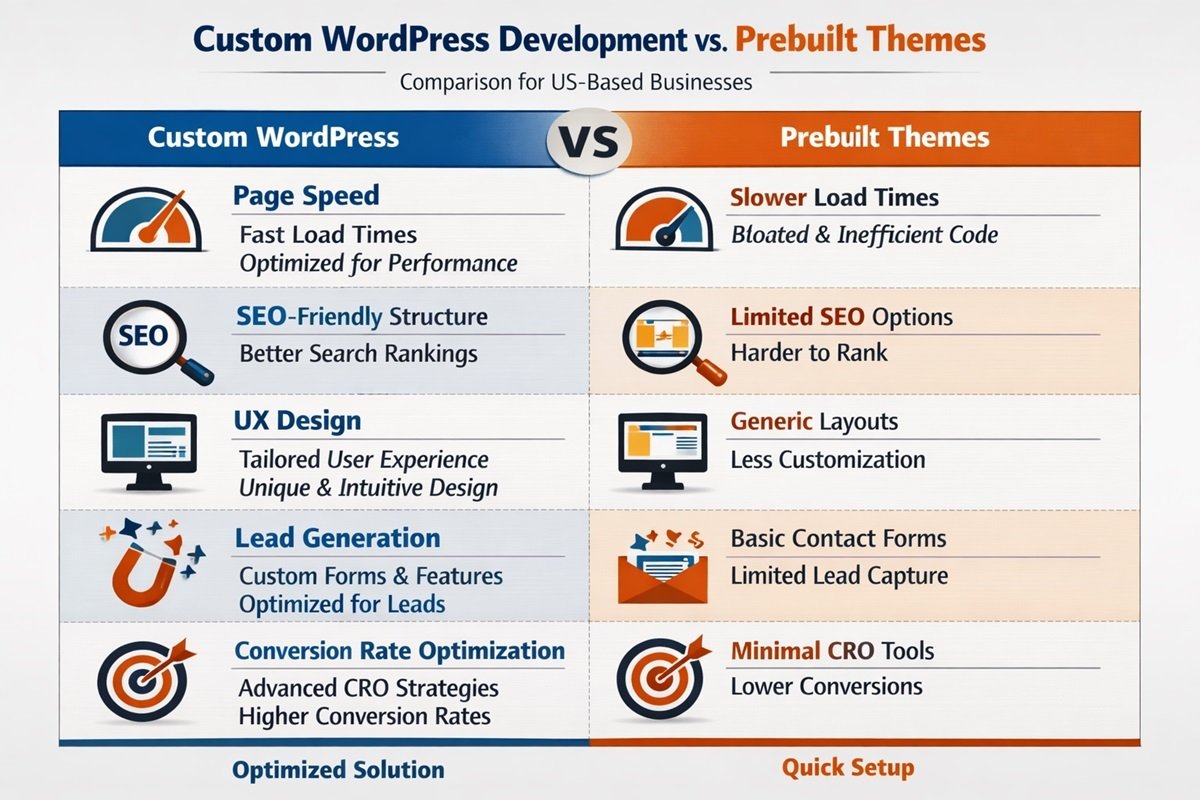
Conversion-Focused Comparison: Custom WordPress vs Prebuilt Themes
| Conversion Factor | Prebuilt Theme | Custom WordPress |
|---|---|---|
| Page Load Speed | Slower due to bloated code and unused features | Fast, lean, and optimized by design |
| Core Web Vitals | Often fails or struggles to pass without extra optimization | Built to meet or exceed CWV benchmarks |
| Lead Generation | Limited CTA placement and layout flexibility | CTAs placed strategically for maximum visibility |
| Checkout Experience (WooCommerce) | Generic checkout with limited customization | Streamlined, branded, and conversion-optimized checkout |
| Bounce Rate | Higher due to slow load times and poor UX | Lower due to fast performance and intentional UX design |
| Mobile Experience | Responsive but not mobile-optimized | Truly mobile-first design |
| SEO Performance | Inconsistent; depends heavily on plugins | Built with clean SEO architecture from the start |
| Brand Differentiation | Looks similar to thousands of other sites | Unique to your business and brand identity |
| Scalability | Hits limits as business grows | Built to scale with your growth |
| Long-Term Cost | Low upfront, higher maintenance and redesign costs | Higher upfront, lower long-term operational cost |
Real Business Scenarios: Which Option Works Better?
Small Business Website
A local service business, such as a plumber, consultant, or dental practice, needs a clean site with a clear phone number, a booking form, and local SEO. A well-chosen prebuilt theme like Astra with a page builder can work here. The conversion needs are simple, and the budget is limited.
Verdict: Prebuilt theme can work, but custom development makes sense if local SEO competition is high or if the business relies heavily on online leads.
eCommerce Store
An online store running on WooCommerce with 200+ products, promotional landing pages, and a cart-to-checkout flow has very specific conversion needs. Prebuilt themes slow down product pages, limit checkout customization, and often create a generic shopping experience that hurts brand trust.
Verdict: Custom WordPress development is strongly recommended for any serious eCommerce operation. The investment pays for itself through improved checkout conversions.
Agency Website
A marketing or design agency’s website is a portfolio and a sales tool. Using a prebuilt theme sends a subtle signal to potential clients: this agency does not invest in their own digital presence. Custom development allows agencies to showcase their capabilities directly through the site itself.
Verdict: Custom WordPress is the clear winner. Your website is your most important sales asset.
SaaS or Startup
A SaaS company needs a marketing site that loads fast, converts visitors into trial signups, and ranks well for competitive keywords. Every second of load time and every unnecessary friction point costs them signups. Prebuilt themes simply cannot deliver the performance and precision that a growth-stage SaaS needs.
Verdict: Custom WordPress development with a conversion-focused architecture is the right move, especially if organic traffic is a key growth channel.
Hidden Costs of Prebuilt Themes
The sticker price of a prebuilt theme ($60 to $300) looks attractive. But the true cost over time often surprises business owners.
Plugin Dependency
Most prebuilt themes need a stack of plugins to function properly: a page builder, a form plugin, a speed optimization plugin, a caching plugin, and often several more. Each plugin adds potential conflicts, security vulnerabilities, and maintenance overhead.
Performance Issues That Require Costly Fixes
When your prebuilt theme site scores poorly on Google PageSpeed, you may hire a developer to “optimize” it. This often means working around the theme’s limitations rather than fixing root causes, which is expensive and only temporarily effective.
Maintenance Complexity
When your theme updates conflict with your page builder, or your page builder updates break your layout, or a plugin update creates a white screen of death, you are dealing with cascading dependencies that are time-consuming and expensive to resolve.
Redesign Limitations
When your business grows and your brand evolves, a prebuilt theme becomes a cage. Redesigning within it is difficult. Migrating away from it often means rebuilding from scratch anyway, which means you pay for a new site despite having paid for the theme and years of plugin subscriptions.
When Prebuilt Themes Still Make Sense
Prebuilt themes are not always the wrong choice. Here are situations where they are a practical option:
- Tight budget: When $5,000 to $20,000 for custom development is genuinely not available
- MVP stage: When you need to validate an idea quickly before committing to a full build
- Temporary sites: Event pages, campaign landing pages, or placeholder sites
- Low-traffic informational sites: Where speed and conversion optimization are less critical
- Personal blogs or hobby projects: Where business outcomes are not the primary measure of success
When Custom WordPress Is the Better Choice
Custom WordPress development is not a luxury. For the right business, it is the most cost-effective decision in the long run.
- Growth-focused businesses: If you plan to scale your traffic and revenue, you need infrastructure that grows with you
- SEO-driven websites: If organic search is a primary acquisition channel, technical SEO quality is non-negotiable
- High-traffic sites: More traffic means more people experiencing every UX friction point; fixing them at scale requires custom control
- Conversion-heavy sites: If your revenue depends on form submissions, product purchases, or demo bookings, every percentage point of conversion rate improvement has direct business value
- Brand-critical businesses: If your website is a key trust signal in a competitive market
- Businesses tired of redesigning every 18 months: A well-built custom site lasts 4 to 6 years with only content and strategic updates
Expert Insights: How to Make the Right Decision
Start With Your Business Goals, Not Your Budget
The most common mistake is framing this as a budget decision first. Start by asking: what does this website need to achieve in the next 12 to 24 months? If the answer involves meaningful revenue generation, lead capture, or organic visibility, then the cost of a custom build is an investment with a measurable return, not an expense.
Calculate the Cost of Poor Conversions
If your site gets 5,000 visitors per month and converts at 1.2%, you are generating 60 leads. If custom development improves your conversion rate to 2.4%, you double your leads without spending more on traffic. That is the math that justifies a custom build.
Mistakes to Avoid
- Do not confuse a page builder with custom development. Elementor on top of a theme is still a prebuilt theme approach.
- Do not assume a premium theme equals a high-performing site. Price does not equal performance.
- Do not delay a custom build until your site is “broken.” Build for where you want to be, not where you are.
- Do not hire the cheapest developer for a custom build. Quality of execution matters more than the approach itself.
- Do not skip performance testing. Insist on Core Web Vitals benchmarks before launch.
Conclusion: Which One Really Drives More Conversions?
The honest answer is that custom WordPress development wins on every conversion-related metric that matters: page speed, UX control, SEO structure, mobile experience, and long-term scalability. Prebuilt themes are a reasonable starting point for businesses with limited budgets or minimal conversion goals, but they have a ceiling that growth-oriented businesses will hit quickly.
If your website is a core part of how you generate revenue and acquire customers, treating it like a commodity is a costly mistake. A well-built custom WordPress site is not just a website. It is a conversion engine designed around your specific business.
If you are serious about improving your online performance, reducing your bounce rate, and turning more visitors into customers, now is a good time to evaluate whether your current WordPress setup is actually built to convert, or just built to exist.
Talk to a custom WordPress developer about what a purpose-built site could look like for your business. The difference in results may surprise you.